Women across the entire charitable giving sector are not just playing a key role-they're paving the way. In recognition of Women's History Month, we're continuing to spotlight the female leaders who are working together across the intersection of philanthropy, wealth management and technology, to see how they're helping to shape our collective future.
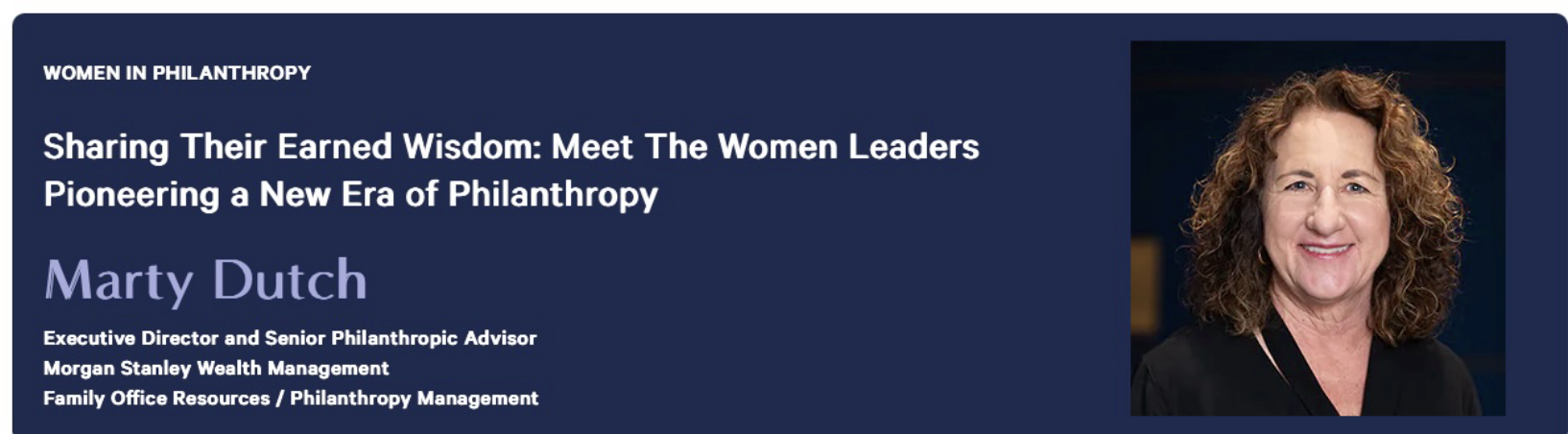
In our next interview, we caught up with Morgan Stanley's Executive Director and Senior Philanthropic Advisor Marty Dutch who is sharing the wisdom she's earned while working in the wealth management sector.
How long have you worked in the wealth management sector? What drew you to it?
I did a career pivot in 2010.1 called it a quest (sounded less lame than announcing I didn't know what I wanted to do next). I told myself to be open-minded and brave, which empowered me to combine my love of philanthropy with my paycheck. I have been active in the nonprofit community for years, and when my kids went off to college, I realized that I could change my career, but to what? So began the quest.
Short version...coffee meetings for advice, interviews for clarity, a circle of wise friends, and Strengths Finder assessment took me on a path to The Heritage Institute, where I found training in family legacy planning. I could see the connection to bring more high net worth individuals into philanthropy. I believed that if more HNW individuals understood the impact philanthropy can make on the nonprofit organization, but more importantly, on their family, they may give more.
What does it mean to you to be a female in a leadership role?
I am very proud of my career and the journey it took to get here. I get to work with amazing women leaders at Morgan Stanley, and I feel proud to stand next to them. My favorite part of this season of my life is the earned wisdom that I can share when younger women are navigating their career. Often, I hear myself saying, men don't think that way at work.
Can you describe a meaningful experience you've had working with a nonprofit or donor?
I became a certified Strengths Coach because of the clarity that I found after taking the Gallup Strengths assessment. My top 5 Strengths were not obvious to me when I first saw the list. I started paying attention when I was having one of "those days': a moment where I was having so much fun, time was flying by, and I was feeling smart and qualified. I was facilitating a board meeting, and I took a moment to look up and realize that I love leading strategy conversations, and I am getting paid to do it.
That is a long introduction to answer your question. A meaningful career is when we get to leverage our strengths. Because my career experience includes consulting with nonprofits AND managing family foundations, I have a set of skills that I get to share every day with clients. I want the clients to enjoy their philanthropic experience, so they stay in the game. Often, they are unaware of how hard giving money away effectively might be.
Guiding them starts with uncovering their values and what they want to change about the world. Do they have heirs and if yes, do they want their family involved? What level of personal engagement? Serve on a board? Systems changing? Anonymous checks? Fundraising? The tactical question comes next, Donor Advised Fund, Private Foundation or starting a Public Charity. I enjoy these conversations because I can paint the picture of the work involved with each option. There is no right or wrong answer but guiding them to think through fiduciary responsibility, personal time commitment and outcomes that they would like to see, can help them avoid a negative philanthropic experience.
I understand how hard it is to run a nonprofit and I want to make sure we create win/win relationships. Helping donors understand the impact of multi-year gifts, funding general operations and leveraging their personal influence and affluence.
Working in this space with clients and nonprofits is a privilege and I found the place where my strengths are used every day to create a meaningful career.
As more women are pursuing successful, lucrative careers and women of the Baby Boomer generation are living longer than men and inheriting vast family fortunes, how have you seen this impact your conversations around their philanthropy?
In the UHNW space I work with many women who have no heirs and after their husband passes, they feel overwhelmed realizing they need to make plans for the assets. Creating a plan with flexibility helps them sleep soundly. Women leading multigenerational families tend to worry about how the assets may impact their children. Philanthropy is not a magic wand that fixes family problems, but it is a terrific tool that can bring families together to learn, grow, and create a family legacy.
What advice would you give to the next generation of women in wealth management as they approach philanthropic conversations with their clients?
Open ended questions during the discovery process are the key to understanding what keeps your clients up at night. Philanthropy conversations are connected to values, and it deepens your relationship with your clients. Philanthropy can be a connector to the next generations and develop relationships. You don't want to be "the parent's advisor�. Finally, philanthropy can be so interesting and fun!
How can women support other women in their organizations?
Being vocal about affirming strengths you see in women when they are using them. Many women think their strengths are “no big deal" because when you are in your flow using your strengths it feels effortless. It may be effortless for you, but not for everyone. If you find yourself saying, “it was no big deal" stop and reflect on what you were doing, what strengths were you using and who were you doing it with? You may find your superpower or help another woman see hers.
What is your favorite book, podcast or product from women creators?
I enjoy Mel Robbins. Her Let Them theory can be freeing.
Have you had any female role models that have inspired you throughout your career?
First, friends who cheered me on during my dark days during the pivot. I remember thinking, they think I can do this, sol better keep going. Second, two women were critical in making my pivot a success. Victoria Collins and Jennifer Cagle, both successful financial advisors, secured a lunch meeting for me with Doug Freeman and Lee Hausner. Doug and Lee had a reputation for family legacy planning, governance and philanthropic planning. At the lunch Doug said, "Why am I here?" My answer changed my career. I said, "I am an independent contractor with training in legacy and philanthropy consulting and every time I have a meeting with advisors, attorneys or CPAs, your name comes up. I am going to assume you have a capacity problem and need to hire me."
We'd like to thank Marty for sharing her story with us! Be sure to keep an eye out for more inspiring interviews with other women leaders throughout this month.
Want to learn more about the ways we support charitable giving?
We have a full range of tech-enabled charitable giving solutions to serve your unique needs. To learn more, schedule a call with us, or reach us at 800-839-0054. Together, let's #begiving.